Saturday, 14 December 2013

Developing the chosen logline

Developing the chosen logline

A  task set in class, was to create three log lines that we could possibly develop into our opening sequence. My personal favourite is the last one I scripted - 'A 22 year old man from the suburbs of London who was threatened for dear life now has to choose between an innocent victim or his family.'

I believe that this log line would be a good basis for an opening sequence as it shows an enigma that could interest the audience to watch on. Loglines are meant to give the reader a basic outline of what the film will be based about and to create an enigma.
Initially I was thinking that the opening sequence would set the atmosphere to the rest of the film. The genre that this film would represent would be a thriller which will create a tense atmosphere to grip the audience. Within the opening sequence, I initially thought that the 22 year old man would be leaving his workplace, get on the local bus taking him close to home and then walking down a dark alley to get to the main street when suddenly he is aggressively approached by two middle aged men with only one thing on both of their minds. They give him the task which is to murder someone within the next 48 hours otherwise he will have to sacrifice his own family. At first he doesn't comply and tries to scamper but the two convicts get him against the wall with a knife to his throat threatening that they will kill him instead if he doesn't do as they ask. This would be the end of the opening sequence. The titles will be included while the young man is on his way home from leaving the workplace to entering the dark alley. They will be in bold capital format to convey that the film is serious.
Picture_4

The audience will wonder why these men want him to kill this man, whether he will do it in time and what will be the outcome in the end. Will he kill an innocent human being? Will he manage to escape the evil challenge or will he sacrifice himself?

Within the opening sequence there will be both diegetic and non diegetic sound. Diegetic from the dialogue of when the man is ruthlessly approached plus the surrounding sounds of the streets and non diegetic being the music being edited in afterwards setting an atmosphere, most likely representing the genre and mood of the film ahead.


Thursday, 12 December 2013

Logline ideas for opening sequences

Logline ideas for opening sequences
Here are a few examples of log lines that could possibly be created into an opening sequence for our coursework.
-A middle aged man moves into a new home in Louisiana where he encounters some very mysterious and supernatural experiences which change his life forever.
-A newly married couple go on their honeymoon to a Caribbean island where they have an adventure of a lifetime.
-An 22 year old man from the suburbs of London who was tricked into killing an innocent victim finds out that what comes around, goes around.

Thursday, 5 December 2013

Opening title sequence remake - Reservoir Dogs

Opening Title Sequence Remake - Reservoir Dogs
In our AS Media group, we were assigned to create a remake of an opening title sequence of a film. We chose to create a remake of Reservoir Dogs which we filmed and edited using Adobe premiere Pro and Adobe After Effects. Below are two YouTube links, one of our opening title sequence remake and one of the actual opening title sequence of Reservoir dogs. Our aim was to replicate the title sequence in a similar way however with a few changes to keep it unique.
Our Opening title sequence remake of Reservoir Dogs


Actual opening title sequence

Tuesday, 26 November 2013

BFI Study day


BFI Study Day

On Thursday 21st November, our media class went to BFI (British Film Institution) South-bank in London to learn some key information on opening sequences concerning how they are made professionally, what consists within them and tips on how to construct one when we come to do so later on in the year.

Pete Fraser conducted the lecture which started on the 5 aspects of genre and the subject of narrative and how enigma is key as it presents a question in the opening title sequence which will be answered later on in the film. We then were showed three opening title sequences including; Catch me if you can, Dawn of the Dead and Napoleon Dynamite. Each sequence displayed a different form of presenting the credits, each in their own unique way. This also included their setting, atmosphere (much influenced by he music) and character. 

tocard_bfi_SE18XTNext we moved onto analysing past student opening title sequences. They ranged from being a poor level 1 to a well produced level 4. The levels depend on the direction on the sequence, whether the sequence presents an enigma and general atmosphere that is created and how well it is created. Other features including and several opening credits and appropriate sound. This was a very good source and information and advice as we were given tips on what to include and what not to. We were able to see the mistakes previous students have made and how we can avoid them to make a more professional and presentable opening title sequence.

In the afternoon session, a film producer was interviewed and described in detail the process in which he helped produce his new film 'Sixteen'. What was learnt was that it is a very tough and time consuming process even to make a film with a low budget as a lot of items have to be thought out. He discussed how it was very difficult to find an appropriate film location that would allow them to shoot the film and one that was not being used at the same time as another film shooting.

Overall the day was a success as it really helped us understand key elements mainly regarding opening title sequences and it gave us advice and how to construct one to a high level. 

A link to Pete's Media Blog; http://petesmediablog.blogspot.co.uk/

Wednesday, 20 November 2013

Hybrid genre


Hybrid genre
Hybrids have larger audiences due to appealing to more people through their multiple genres. This would be more lucrative for the film companies. Some people consider them more exciting and creative for example a Rom-Com like Friends with Benefits. Hybrid Theory’s which can also be referred to as cross media due to two different genres merging together for example a horror genre and a action genre combining together this means that there will be horror scenes available in the film as well as action scenes this could attract more people to watch a film due to having two genres in one film.  This could also mean more value for money due to two genres in one film as mainly you may only be getting one genre i.e. a comedy genre etc.  Hybrid Theory’s has been said to be the future of marketing as well as socialising due to being able to communicate to the audience in various amount of ways by speaking as well as actions made in movies.  This has also been said to be more exciting and creative when watching films due to having more involvement in the film instead of just one genre involved.  

As horror movies are perennially popular, film-makers might start with a set of horror. Paradigms to guarantee audience interest, before throwing other tropes in to the mix.

"Genres are not static, but evolve. Therefore, their common attributes change over time. 
Most films are hybrid genres, since they possess common attributes of more than one genre". By Warren Buckland 

A popular example of a hybrid genre is 'Friends with Benefits' which is a RomCom.

Examples of Hybrid Genres:
  • Romantic Comedy- Genres Involved- Romance and Comedy
  • Comedy drama - Genres involved - Comedy and Drama
  • Action Comedy - Genres involved- Action and Comedy
  • Romantic Fantasy- Genres involved - Romantic and Fantasy
  • Horror Drama- Genres involved - Horror and Drama

Independent Vs Hollywood

Independent Vs Hollywood
 
 
Independent Film

An independent film is one which is made away from the control of a large corporation, for example funding or creative input. So no film could really be called an independent film unless it is totally funded produced and distributed privately. It is therefore unlikely that any film can truly and totally be called an independent film.


It has been said that if 50% of the budget is raised away from a major studio it would be an independent film but this is debatable since a studio with a 50% investment would certainly not leave the production alone but would exert plenty of influence. Also, this begs the question of what is a ‘major’ studio as often smaller studios can morph into bigger players (see below). Certainly, if any money comes from a major, it would be a small part of the budget.


Independent cinema is therefore more of a relative term and it has come to mean that there is less input or interference from the large film companies (i.e. the Hollywood companies, Warner Bros, Disney, 20th Century Fox and Paramount, etc.) than in a mainstream film.
 
hollywood sign - Hollywood Sign Wallpaper
Most films to date are directed and produced in major film studios such as Hollywood. As these films are backed by film distributors including 20th Century Fox and Universal, they have the funds to create very expensive scenes with special effects and they tend to be more viewed and received compared to independent films. Furthermore, they are more addressed to the public as they have the funds to afford advertising so the public is aware of its release.


Reservoir Dogs: Quentin Tarantino

The circumstances and spirit in which they were made, second, the quality of the result and, finally, its mark on the movie world. This is how Reservoir Dogs gained consensus as the winner. Consider firstly the film's creation: script written in two weeks while the author was in a dead-end day job, it barely changed from first draft to shooting script, and attracted attention by word of mouth. It garnered rave reviews, but Dogs' box office performance wasn't great - again, it had to wait for word of mouth. Most importantly, the magnitude of effect this one film has had on indie culture in the last 13 years is, to say the least, overwhelming. The fact is that more than one generation has had their eyes opened to the long-snubbed world of movie-making's outsiders, be it American mavericks, foreign actioners, or just plain old B-pictures. If it wasn't for Dogs, Hong Kong action cinema would still be a lot more marginal than it is today, and nobody would likely have got around to transferring Blaxploitation titles onto DVD yet.

Thursday, 14 November 2013

The Rise and Fall of the Western genre

The Rise and Fall of the Western Genre


Over time, different genres take over the film industry due to popularity. An example of this is the original western genre in the 1920s and 30s. They were vastly popular however over time, audiences began to expect the same plotline for every film. For westerns the main plotline was that that there was a lone man that fights against the evil in a classic western setting isolated from orthodox society. The lone man is usually a romantic figure as well a strong figure but it was almost known from the beginning that the good would beat the evil and everything would end well.
the-good-the-bad-and-the-ugly-clint-eastwood-eli-wallach-sergio-leone<- Clint Eastwood in 'The Good, the bad and the ugly'
 
Consequently to the plot being very similar in most westerns, the popularity of then dropped by the 1940s and audiences turned to other genres which were new and different. However in the 1960s, a new form of the western was invented. Started by Italian film producers, the new 'Spaghetti Western' genre was created which differed from the original western genre. The setting of the new spaghetti westerns were similar to the original westerns, usually set in an isolated western town in the American desert separated from orthodox society. The main character was still the untamed lone cowboy that fights against evil however the difference in the character is that the romance side is lost and is more aggressive.


Notable producers of the spaghetti westerns are Sergio Leone producing 'A Fistful of Dollars' in 1964 starring Clint Eastwood and Quentin Tarrantino. Overall, the sub genre of the Spaghetti Western was a success especially in the USA and Italy where they were widely produced until the late 1970s. After then, the genre of western died down again and other genres have once again taken over. The occasional westerns since that have been well received include Unforgiven produced in 1992 directed by Clint Eastwood himself.
unforgiven-clint-eastwood-morgan-freeman<- 'Unforgiven' from 1992
 

Wednesday, 13 November 2013

Continuity editing


Continuity editing
 
 Continuity editing is a system of cutting used to maintain continuous and clear narrative action by following a set of rules. Benefits of continuity editing would include that the narrative has structure, the shot sequences flow smoothly into each other making it easier to follow the film. There are certain rules that continuity editing has to follow including the establishing shot, shot/reverse shot and the 180 degree rule.

 
The rules of continuity editing
 
 The establishing shot - A long shot or extreme long shot, usually with loose framing that shows the spatial relations between the important figures, objects and setting in a scene.
 
Shot/reverse shot - This rule is where two shots are edited together that alternate characters, typically in a conversation situation. An example is where the character(s) in one frame look left and in the other frame the character(s) look right showing a realistic line of sight.
 
The 180 degree rule - The angle between any two shots consecutive shots should not exceed 180 degrees, in order to maintain spatial relationships between people and objects in any given sequence of shots.
 
The 30 degree rule - The angle between any two shots consecutive shots should not exceed 30 degrees, in order to maintain spatial relationships between people and objects in any given sequence of shots.

Crosscutting - Editing that alternates between shots occurring simultaneously in two or more different locations. 
 
match on action - A cut between two shots that places two different framings of the same action next to each other, making it seem to continue interrupted.
 
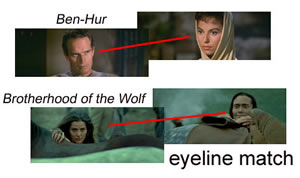
Eye line match - A cut between two shots, in which the first shot shows a person looking off in one direction, and the second shot shows either a space containing what he or she sees, or a person looking back in exactly the opposite direction.

Editing

Editing


Within film there is a great deal of editing that stitches it all together. Editing can be in the form of the variations of camera shots that are used and how they change form one to another. It is important within film that the editing is performed as it gives the audience a more open minded view of the situation in the film. Another major form is the switching of scenes. How it is performed is the way it is edited. There are many forms of transformations between scenes that give different effects. Whether it is a fade or a jump cut, if there was no editing, there would be no transformation that would make film on a whole very different. Other forms of editing include special effects, continuity editing and different pace and rhythms.

Forms of editing 

Special effects - Probably one of the most recognised forms of editing, special effects are used by film makers to create scenes that would be difficult to create naturally. By using computer graphics, special effects from huge explosions to scenes of science fiction can be used to create extraordinary scenes.
2012_la_limo_058_110_pubstill.jpg


Transitions - Being used in almost all film, transitions separate two different scenes with certain effects. a few are listed below.

Dissolve/cross fade - This transition is where the preceding shot merges with the following shot resulting in the two shots being superimposed. The longer the dissolve is, the more noticeable the superimposition becomes. In a dissolve transition, both scenes can be seen at one, not very clearly as one is fading away while the other is becoming clearer.
  Fade - This transition is where the preceding shot fades into black from which the following shot emerges. The fade transition is very common at the end of films where the last scene fades the black and the closing credits appear.

Wipe - the wipe is a simple transition where the preceding scene is 'wiped' with the following scene. This is a fairly old transition, being used a lot in black and white films as it
 is a simple transition to perform.                                                        ^
                                                                      An example of a wipe transition from Star Wars

   
 Shot Duration/ Pace and Rhythm - In most circumstances, the duration of a shot will reflect the narrative context. Generally short shot duration conveys action and urgency (for instance in a chase scene). A long shot duration creates a slower pace shows intensity and intimacy with the narrative. it allows the audience to focus on facial expressions and mise en scene which would otherwise be missed.


Thursday, 7 November 2013

Conventions of opening seqeunces

Conventions of opening sequences
 
 
One of the main conventions of an opening title is the movie title and opening music. The movie title will appear either at the start or the end of the opening credits. The music also is key as it sets the mood of the film while catching the audiences attention. As well as setting the mood, the opening music will suit the film genre which will build up atmosphere and possibly tension for the first scene.
 
As well as the movie title, the names of the main cast and crew including the director and producer will appear on screen. The production companies will also appear during the opening title credits.
 
 
During or after the opening credits, a main setting will be introduced as well as one or more characters, sometimes being the main roles as well as others. during this sequence, mise en scene including costumes, settings and props will be used. Editing will be apparent during the opening sequence. this could contain a montage of flashback shots from different times and settings.
 
 
Cinematography and camera work will be greatly used in the opening sequence. The sequence will include a variety of shot types including close ups to show detail and master shots to show just about everything within the scene. There should be a range of different angles and camera angles that will all contribute to build up atmosphere and give an insight to the film.
 
The genre of the film should become apparent during this sequence through camera work, music and settings. The sequence should also give an insight to the film without revealing the story of the film too much, making the audience ask questions about what will happen next.


Monday, 4 November 2013

Log Line

Log Line

A logline is a one-sentence summary of your script. It's the short blurb in TV guides that tells you what a movie is about and helps you decide if you're interested in seeing it. It's the grabber that excites your interest. A logline always poses a question in the audience's mind to help hook them into watching


Log lines are very important as it is a short piece of information on the content of the program so that the audience will know what they will be watching. It relates greatly to blurbs on the back of books. The blurb does not give the story away but gives an insight of what to expect including what genre it may be so that the audience will know whether it it is right for them.


How does a logline help you sell your screenplay?
When your screenplay is ready to sell, your query letter to agents, producers, and directors 
must contain a logline. Sometimes, they don't read past the logline. So, if you don't grab 
them with your logline, you won't have any chance of getting them to read your entire 
screenplay. The logline is literally a sentence or two long so it has to present the general 
aspect of the film with a bit of its storyline very briefly. 


History of opening sequences


History of Opening sequences

Since the invention of the cinematograph, simple title cards were used at the start and end of silent film presentations in order to identify both the film and the production company involved, and to act as a signal that the film had started and then finished. In silent cinema title cards were used throughout to present dialogue and plot and it is in some of these early short films that we see the first examples of title sequences themselves, being quite literally a series of title cards shown at the beginning of a film. The arrival of sound did little to alter the convention except that the sequence was usually accompanied by a music.
This remained the convention for many years until the introduction of television forced the major film studios to invest in developing cinema in order to win back a diminishing audience. The "cast of thousands" epics shot on various patent widescreen formats were a direct response to television's successful invasion of the leisure marketplace. 
Part of cinema's new important and expansive quality were orchestral musical preludes before the curtains opened and long title sequences which all designed to create a sense of excitement and it was hoped television would be unable to compete with. As cinema's title sequences grew longer we begin to see the involvement of graphic design such as Saul Bass, which directly influenced the 1960s television predilection for creating strong graphics-led sequences for many shows.
Film-Makers at the beginning of the 21st century have many options open regarding title sequences. Some films superimpose opening credits over the opening scenes, while others elect to do away with titles entirely, instead including present title sequences at the end of the movie.
Due to the commercial environment of television broadcasting, most series have regular and identifiable title sequences.
ll
The two images shown are of title sequences of the 1930s which show that the actors names were presented big and bold to grasp the audience.

Wednesday, 23 October 2013

Synergy

Synergy
Synergy is the coming together of multiple elements in a system to create an effect different or greater than the sum of their individual effects. The equation for synergy is 1+1=3. This may not seem to make sense to most people but business it means to success of two separate businesses joining together and making more profit and success than the two individuals acts would by themselves and that is exactly what synergy is.

Key points of Synergy

Synergy is an important part of a film’s marketing campaign. It involves making the public aware of the film’s existence. Synergy is the main reason for the success of the major film producers, who own Hollywood, and for their dominance over independents worldwide. Synergy is also a key reason for the studio’s preference towards safe films, because the safer the investment the more likely it is that they will be able to attract corporate partnerships. The synergy opportunities developed for a film can often be more profitable than the film itself and keep the film brand in public awareness and is ideal if the studios are planning a sequel.
Examples of Synergy being used
 
The Avengers is perhaps one of the greatest examples of the extremes synergy can be taken.  The film is based on pre-existing property and has raised the profile of its comic book characters, most of the characters have been features in spin-off television animation series, re-issues of the old comic books, or re-branded new comic book series. Tie-ins have been arranged with fast food restaurants such as McDonalds (for their happy meals), Dunkin’ Donuts and Baskin Robbins and fizzy drinks, such as Pepsi.
However, the most unique facet of The Avengers marketing and synergy campaign is that each of the protagonists has their own film(s) which have been used to market The Avengers. Each of these films has had tie-ins, product placement, merchandise, computer games and spin-offs and each is based on pre-existing property - which has been exploited and promoted by the film’s release. Iron Man, Thor and Captain America have been film franchises in their own rights, but from the build up to the release of Thor it has been clear that they are all part of the campaign for The Avengers.
Marvel was bought by Disney, however a pact was organised between Marvel and Paramount Pictures to produce a slate of comic book films. The inter-relationship between two organisations owned by two different conglomerates: Disney and Viacom respectively, expresses the oligopoly nature of Hollywood. From 2012 this relationship will end leaving both with sizeable profits and Disney will continue to distribute the later films, including Iron Man 3 and The Avengers.


Saturday, 19 October 2013

Film Marketing


Film Marketing
Film marketing is the process that film studios undertake of promoting a film that they have produced. Film studios will invest in expensive marketing campaigns in a hope to maximise the revenue their film makes. What film marketing is supposed to accomplish is to attract the public in wanting to watch the film. The process will usually be taken on before or during the films release so that the public will have a chance to actually go to the cinema to see it. However it doesn't end while the film is still showing in cinemas. Even though the majority of the film marketing process is taken during this time, after it has been in cinemas, advertisements for its DVD release will soon be released which will help to maximise the films revenue. The practice of film marketing is an expensive investment however it can crucial if the film is to be successful.   <= An example of a film trailer being showed on a YouTube advertisement.


Techniques of film marketing

There are many different forms of film marketing, all of which have a different role but all have the same aim which is to maximise the films revenue.

In the cinema itself, trailers for the film will be shown before the showing of another film. This process of showing a trailer can also be shown on TV and advertisements on the internet which has a much larger audience. Trailers are a key technique as it will give a brief insight into what the film is about and what genre it is so the public will know if the film would be of their liking. Other techniques in the cinema might include items such as cardboard cutouts of a character in the film and posters which will include its release date. Again posters can be displayed in other places than the cinema.

Techniques of film marketing that can be shown on the internet can include advertisements like still shots or the trailer as said before. Websites such as YouTube allow for advertisements to be shown before a video which can be a key aspect of internet marketing for the film. Another technique on the internet is the films own website. Many film companies have made a website for public viewing that gives an insight to the film and can evoke a lot of interest. Examples of films that have included websites include; 007 Skyfall and Prometheus  Both films were very popular and successful and the fact that they both had their own website may have played a key part.

The last major element of film marketing I will discuss is merchandising. Merchandising is the act of producing and selling collectibles, books, toys and other items related to the film. They can be widely popular and many films have produced merchandise to go with their film. What is does is it increases the revenue of the film as the viewers that liked and enjoyed the film may want to purchase something related. The DVD release of the film does go in the bracket of merchandising and is probably the most popular item the film company will sell. The viewers that enjoyed the film might want to see it again but after the film has stopped being shown in cinemas, the easiest way to see it is to buy the copy. The DVD can be used in the public's own home and can be viewed whenever. Almost every film company will have produced a DVD version of their film as it greatly adds a vast amount of revenue.


Above - Two examples of film merchandising in the act of collectibles and toys

Thursday, 17 October 2013

Film Distributions


Film Distributions


The distribution of a film is the process through which a movie is made available to watch for an audience by a film distributor. The process may be executed in a number of different ways; for example, with a theatrical release, a home entertainment release (in which the movie is made available on DVD-video or Blu-ray Disc) or a television program for broadcast syndication and may include digital distribution. The distributors also create a marketing campaign before, during and after the film is released which includes then producing posters, trailers, websites, press packs and possible competitions. This campaign will maximise the publicity for the film which will help the film become more successful. Distributors also obtain the BBFC certificate, and try to get films released at the most favourable times of the year for their genre.


How Film Distribution works
 
In film distribution, there is a specific path that takes the film from the producer to the audience. It all starts when someone has an idea for a movie. They create an outline for the film to promote interest for a studio or independent investor to purchase the rights for producing the film. When the studio or independent investor has got the rights to the film, people are brought together to make the film including the screenwriter, director, producer and cast. When the film is completed it is sent to the studio and the studio makes a licensing agreement with a distribution company. The distribution company will decide how many copies or the film to make before releasing it. The distribution company will then show the film screening to destined buyers representing the theatres. The buyers will then negotiate with the distribution company on what movies they intend to lease and the terms of the lease agreement. The prints of the film are released to the theatres and cinemas a few days before the opening day to be prepared for viewing. When the film is officially released, it will be shown in cinemas for several weeks. During this period, the public can buy tickets to watch the movie. At the end of engagement (the time the film is shown in cinemas), the theatre sends back the print to the distribution company and makes the payment on the lease agreement.


Media Institutions


Media Institutions


 An institution is something in society that plays a major role in people’s lives. Thus, the family, school, the NHS are all ‘institutions’.


The media plays a massive part these days in everyone’s lives – and that’s why we speak of ‘media institutions’.


But there is a key difference between the family, the health service and school and media companies.


The first three are there to serve us all; the last works to serve its shareholders.


A media institution is an established, and often profit based organization, that deals in the creation and distribution of advertising, entertainment and information services. It helps in gathering information, and perceptions about different groups of people and their originality.
 
Media institution can be defined as the cultural and political conventions within which media products are constructed and disseminated. It also describes the people who have a role in the production process of media texts, the companies/organizations they represent and the process of production, distribution and marketing.
 
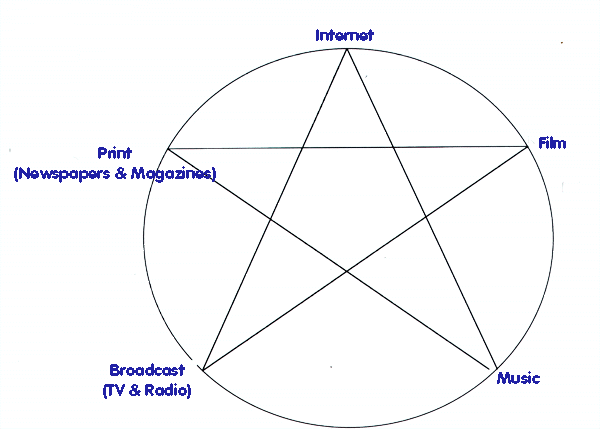
There are different types of media institutions depending on the format, including TV, film, internet, music and print. Popular TV and film media institutions include; The BBC, ITV, Sky, Time Warner, Universal and ESPN. Print is another form of media institute as news stories and information is put out to the public by newspapers. Newspapers may not be as popular as they used to be because of the internet but enough people read them for them to effective.


Tuesday, 15 October 2013

Gender Representation in Thriller films


Gender Representation in Thriller films

Men

Throughout the genre of Thriller, there are various representations that men portray that are recurring. The main representations are that men are physically and mentally strong as this helps them get through the plot. If they are the protagonist, they are most likely to be the hero to come and help to put things right. Men also tend to be brave and intelligent within the genre as they take the main role and are looked up to. There is also a recurring theme throughout thriller films that men tend to be the 'lone hero' and very independent, which also backs up their character to be mentally strong and doesn't suffer much from emotion.

An good example of a well known character within the thriller genre is James Bond. Within the James Bond series, each actor that has portrayed him is a strong, brave and intelligent man. They would especially take on these characteristics if they were the best spy in the country. James Bond takes on the threats of a country usually by himself while taking some commands such as his objectives from his base, MI6. At the end of the films, after defeating the antagonists, it is shown that it was just like another day in the office for him and moves on.

Women


In Thriller films, women often portray a role of purity and innocence. The men within this genre almost always take the leading role and portray a mentally and physically strong figure. However sometimes women may play a role as a sidekick for the leading role to help them along their journey however most often the leading role will be independent and will go on alone. It is widely seen that women are dependent on men in this genre however they can also be intelligent and sly. One main reason why women may be put to the roles of being innocent and harmless is because the Thriller genre often involves a great deal of fighting and action between the antagonist and protagonist which are men. Women are not seen to be physically violent which also answers why they would be dependent on men. In some instances, women might be the centre of the action however thriller involves a lot of traditional views so it would not be seen correct for them to take that role. Both genders are greatly stereotyped, however in very different ways. Men are usually portrayed as being very masculine and the heroes whereas women are seen as being very passive and non independent.

Monday, 14 October 2013

Film Ratings


Film Ratings
All classifications decisions are based on the BBFC's published are regularly updated Guidelines. The guidelines are the product of extensive public consultation, research and the accumulated experience of the BBFC over many years. They reflect current views on film, DVD and video game regulation.
Types of classification
There are six different types of film classification currently used in the UK, they are as follows:
  • U – The “U” rating indicates the film in question is suitable for all, or is universal. Despite this name, it is generally used as mere guidance and suggests that the film may still be unsuitable for children younger than four as it is extremely difficult to ascertain or predict how they may react. A U-rated film will have a positive message and be generally upbeat.
  • PG – A film rated a PG (parental guidance) may be seen by all, including children without their parents. Parents are advised that some scenes may be unsuitable for children below the age of eight and it is therefore a judgement call for them to make as to how their child will react. Although a PG may be seen by all, it is perhaps unlikely a child of less than eight years old will be allowed to see a film without an adult.
  • 12 or 12A – There is no appreciable difference between a film marked 12 or 12a and they are thus treated as one group of film classification. Anybody wanting to see a film marked with this classification must be either over 12 years old or be accompanied by an adult. Therefore, if in the parent’s judgement the film would not be unsuitable for their child then they may take their child to watch it with them.
  • 15 – If you wish to see a film marked 15 you must be at least that age. Even if you go to see the film with your parents, by law you should not be able to see the film if you are not yet 15.
  • 18 – The 18 category is simply that, you must be 18 or over or you will not be allowed to watch the film. You cannot therefore simply go in with someone who is 18 and expect to be let in with them.
  • R18 – This category of films will only be shown in certain licensed cinemas and will not be available at your local video shop. They generally contain explicit sexual content and there is therefore far stricter regulation of the supply of this category of film.


Below is a good link on how to understand ratings;
http://www.bbfc.co.uk/